

Co-Producing
a Transboundary Flood Early Warning System
Slapis Sahel
Project
SLAPIS SAHEL Project
Iterative social learning
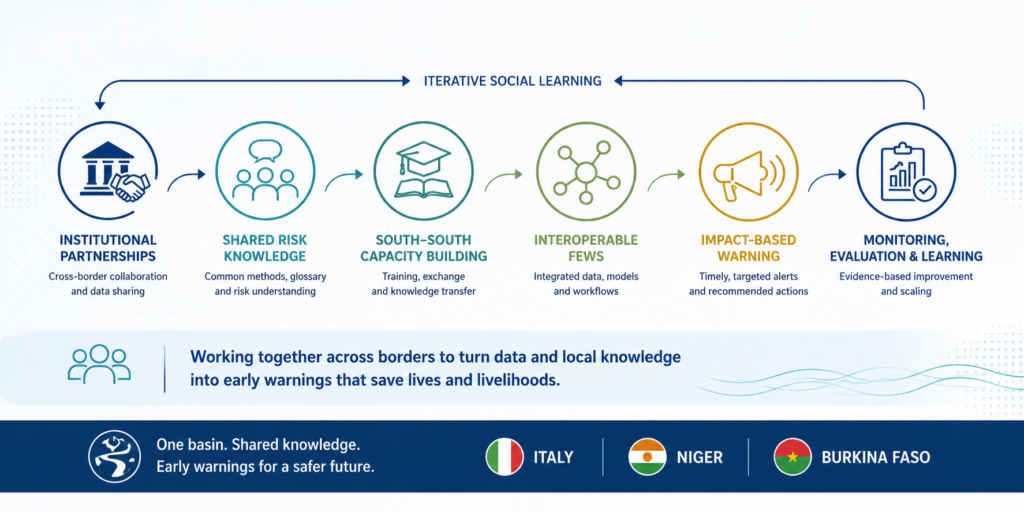
Working together across borders to protect communities at risk
Floods do not stop at national borders. Along the Sirba River, which flows from Burkina Faso into Niger before joining the Niger River, flood waves generated upstream can threaten downstream communities hundreds of kilometres away. Effective flood early warning therefore requires not only accurate forecasts, but also close cooperation between the institutions responsible for monitoring, forecasting, emergency management and risk communication in both countries. SLAPIS Sahel was created to address this challenge by extending the successful SLAPIS Niger experience to the entire transboundary Sirba River basin. Rather than simply transferring technologies, the project promotes the co-production of climate services, ensuring that all institutions involved jointly contribute to the design, implementation and continuous improvement of the flood early warning system.
What does co-production mean?
Co-production is a collaborative approach in which scientists, technical services, public authorities and local stakeholders work together throughout the development of a service. Instead of designing an early warning system first and asking institutions to adopt it afterwards, SLAPIS Sahel develops the system jointly with institutions and users. This ensures that forecasts, warning procedures and communication tools respond to real operational needs while remaining compatible with national institutional responsibilities.
From a national to a transboundary system
SLAPIS Sahel builds on more than ten years of experience gained through the implementation of the local flood early warning system in Niger. The transboundary expansion required much more than extending the geographical coverage of the system. It involved creating new forms of collaboration between Burkina Faso and Niger, aligning operational procedures while respecting national mandates, strengthening technical capacities and establishing permanent mechanisms for cooperation between homologous institutions.
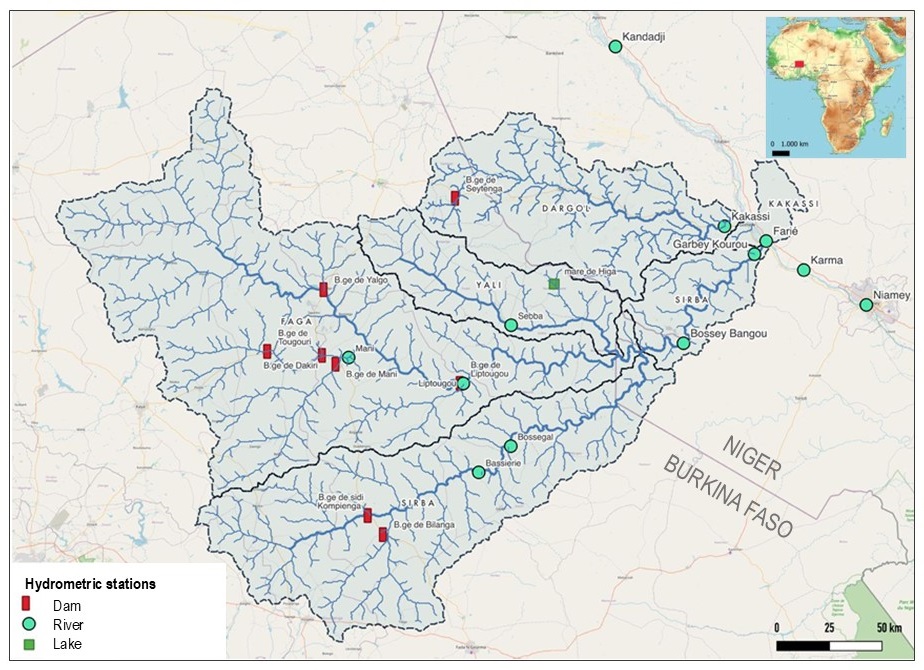
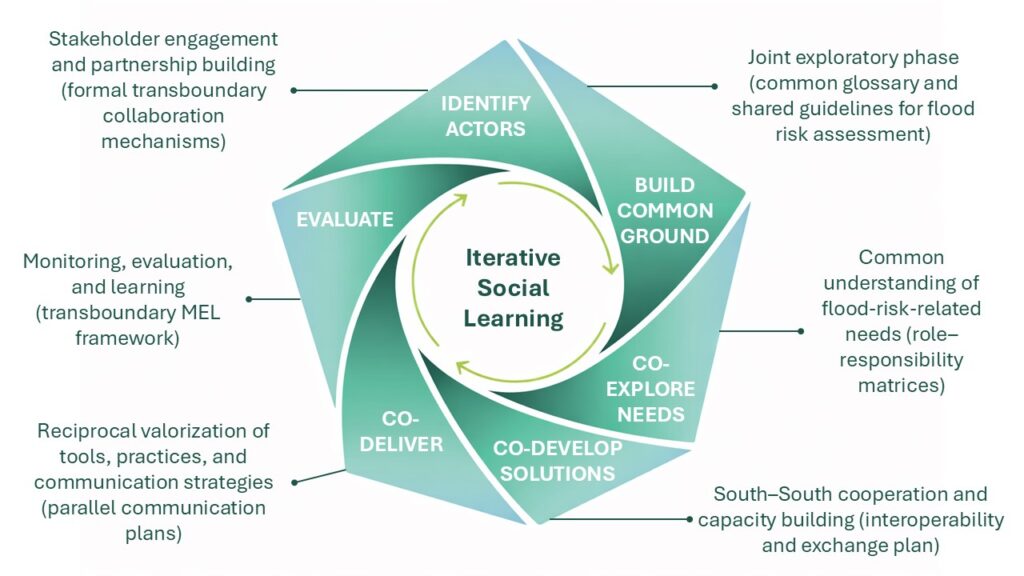
Developing institutional partnerships
Meteorological Services, Hydrological Services, Civil Protection authorities, local governments and technical partners from both countries work together through formal collaboration agreements and designated focal points.
Building common ground
Joint workshops allow institutions to develop a common understanding of flood risk, harmonize terminology and jointly define methodologies for flood risk assessment.
Joint identification of needs
Rather than assuming common needs, institutions jointly analyse their operational responsibilities, identify technical gaps and define priorities for strengthening forecasting and warning capacities.Co-developing solutions
Risk assesment, forecasting tools, operational procedures, communication products and technical capacities are developed collaboratively. Particular emphasis is placed on South–South capacity building, enabling expertise developed within one National Meteorological Service to be transferred directly to another.
Co-delivering warnings
Instead of imposing identical procedures in both countries, SLAPIS Sahel promotes interoperability. Each country maintains its own institutional warning chain while ensuring that forecasts, information and operational products can be exchanged efficiently across the border.
Learning and improving
The system is continuously reviewed through Monitoring, Evaluation and Learning (MEL), allowing partners to improve procedures, strengthen collaboration and progressively increase institutional ownership.
A practical approach to transboundary cooperation
One of the main lessons emerging from SLAPIS Sahel is that successful transboundary cooperation does not require complete harmonization of national procedures.
Instead, the project promotes interoperability: allowing institutions with different mandates, procedures and organizational structures to work effectively together while preserving their national responsibilities.
This pragmatic approach makes cooperation more feasible and more sustainable, particularly in regions where institutional contexts differ significantly across borders.
Strengthening institutions beyond the project
Co-production generates benefits that extend beyond the technical performance of the flood early warning system itself. Through repeated joint activities, operational exchanges and shared problem-solving, SLAPIS Sahel contributes to:
- strengthening long-term institutional partnerships;
- developing communities of practice across borders;
- promoting South–South knowledge exchange;
- increasing institutional ownership of forecasting and warning services;
- creating conditions for the long-term sustainability of the system.
Towards Early Warnings
for All
By combining scientific forecasting, institutional cooperation and community engagement, SLAPIS Sahel contributes directly to the objectives of the United Nations Early Warnings for All (EW4All) initiative.
The experience gained in the Sirba River basin demonstrates how co-production can support the operational development of flood early warning systems in shared river basins and provides practical lessons that may be adapted to other transboundary contexts across Africa and beyond.